 Add to Chrome
 Add to Firefox
 Add to Edge
AllShowers: One model for all calorimeter showers
Jan 16, 2026
Accurate and efficient detector simulation is essential for modern collider experiments. To reduce the high computational cost, various fast machine learning surrogate models have been proposed. Traditional surrogate models for calorimeter shower modeling train separate networks for each particle species, limiting scalability and reuse. We introduce AllShowers, a unified generative model that simulates calorimeter showers across multiple particle types using a single generative model. AllShowers is a continuous normalizing flow model with a Transformer architecture, enabling it to generate complex spatial and energy correlations in variable-length point cloud representations of showers. Trained on a diverse dataset of simulated showers in the highly granular ILD detector, the model demonstrates the ability to generate realistic showers for electrons, photons, and charged and neutral hadrons across a wide range of incident energies and angles without retraining. In addition to unifying shower generation for multiple particle types, AllShowers surpasses the fidelity of previous single-particle-type models for hadronic showers. Key innovations include the use of a layer embedding, allowing the model to learn all relevant calorimeter layer properties; a custom attention masking scheme to reduce computational demands and introduce a helpful inductive bias; and a shower- and layer-wise optimal transport mapping to improve training convergence and sample quality. AllShowers marks a significant step towards a universal model for calorimeter shower simulations in collider experiments.

CaloChallenge 2022: A Community Challenge for Fast Calorimeter Simulation
Oct 28, 2024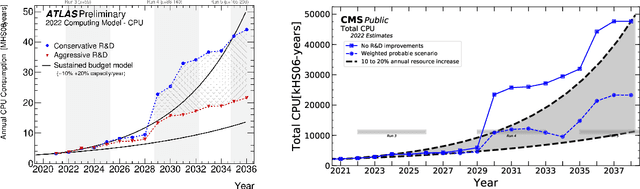
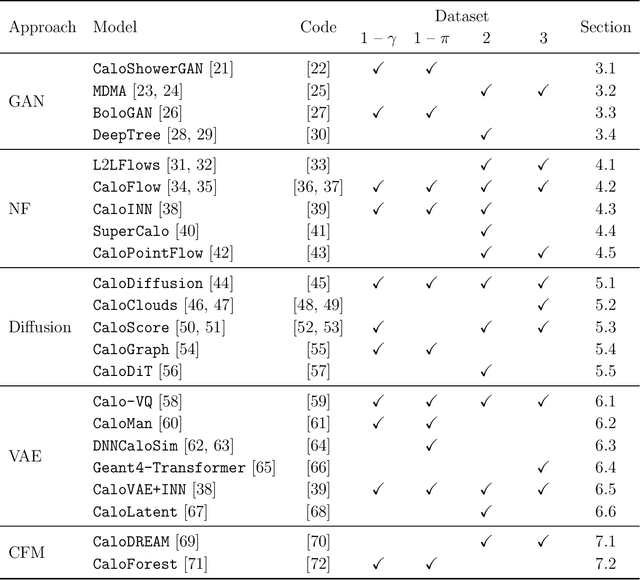
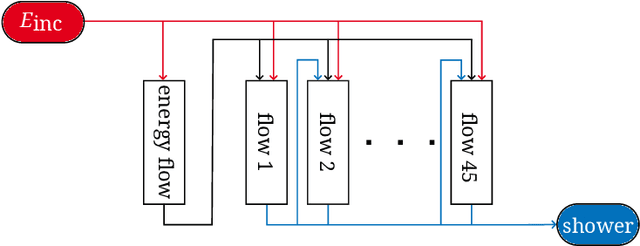
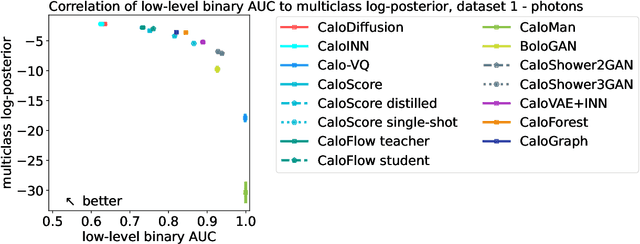
We present the results of the "Fast Calorimeter Simulation Challenge 2022" - the CaloChallenge. We study state-of-the-art generative models on four calorimeter shower datasets of increasing dimensionality, ranging from a few hundred voxels to a few tens of thousand voxels. The 31 individual submissions span a wide range of current popular generative architectures, including Variational AutoEncoders (VAEs), Generative Adversarial Networks (GANs), Normalizing Flows, Diffusion models, and models based on Conditional Flow Matching. We compare all submissions in terms of quality of generated calorimeter showers, as well as shower generation time and model size. To assess the quality we use a broad range of different metrics including differences in 1-dimensional histograms of observables, KPD/FPD scores, AUCs of binary classifiers, and the log-posterior of a multiclass classifier. The results of the CaloChallenge provide the most complete and comprehensive survey of cutting-edge approaches to calorimeter fast simulation to date. In addition, our work provides a uniquely detailed perspective on the important problem of how to evaluate generative models. As such, the results presented here should be applicable for other domains that use generative AI and require fast and faithful generation of samples in a large phase space.
CaloClouds II: Ultra-Fast Geometry-Independent Highly-Granular Calorimeter Simulation
Sep 11, 2023Fast simulation of the energy depositions in high-granular detectors is needed for future collider experiments with ever increasing luminosities. Generative machine learning (ML) models have been shown to speed up and augment the traditional simulation chain in physics analysis. However, the majority of previous efforts were limited to models relying on fixed, regular detector readout geometries. A major advancement is the recently introduced CaloClouds model, a geometry-independent diffusion model, which generates calorimeter showers as point clouds for the electromagnetic calorimeter of the envisioned International Large Detector (ILD). In this work, we introduce CaloClouds II which features a number of key improvements. This includes continuous time score-based modelling, which allows for a 25 step sampling with comparable fidelity to CaloClouds while yielding a $6\times$ speed-up over Geant4 on a single CPU ($5\times$ over CaloClouds). We further distill the diffusion model into a consistency model allowing for accurate sampling in a single step and resulting in a $46\times$ ($37\times$) speed-up. This constitutes the first application of consistency distillation for the generation of calorimeter showers.
CaloClouds: Fast Geometry-Independent Highly-Granular Calorimeter Simulation
May 08, 2023Simulating showers of particles in highly-granular detectors is a key frontier in the application of machine learning to particle physics. Achieving high accuracy and speed with generative machine learning models would enable them to augment traditional simulations and alleviate a major computing constraint. This work achieves a major breakthrough in this task by, for the first time, directly generating a point cloud of a few thousand space points with energy depositions in the detector in 3D space without relying on a fixed-grid structure. This is made possible by two key innovations: i) using recent improvements in generative modeling we apply a diffusion model to generate ii) an initial even higher-resolution point cloud of up to 40,000 so-called Geant4 steps which is subsequently down-sampled to the desired number of up to 6,000 space points. We showcase the performance of this approach using the specific example of simulating photon showers in the planned electromagnetic calorimeter of the International Large Detector (ILD) and achieve overall good modeling of physically relevant distributions.